Size guides
Ring guide

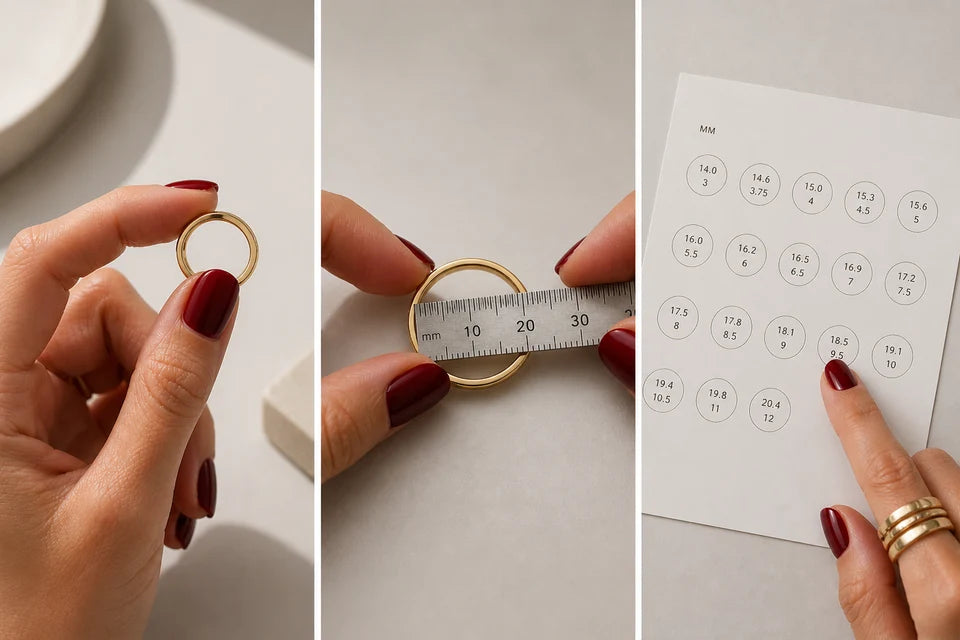
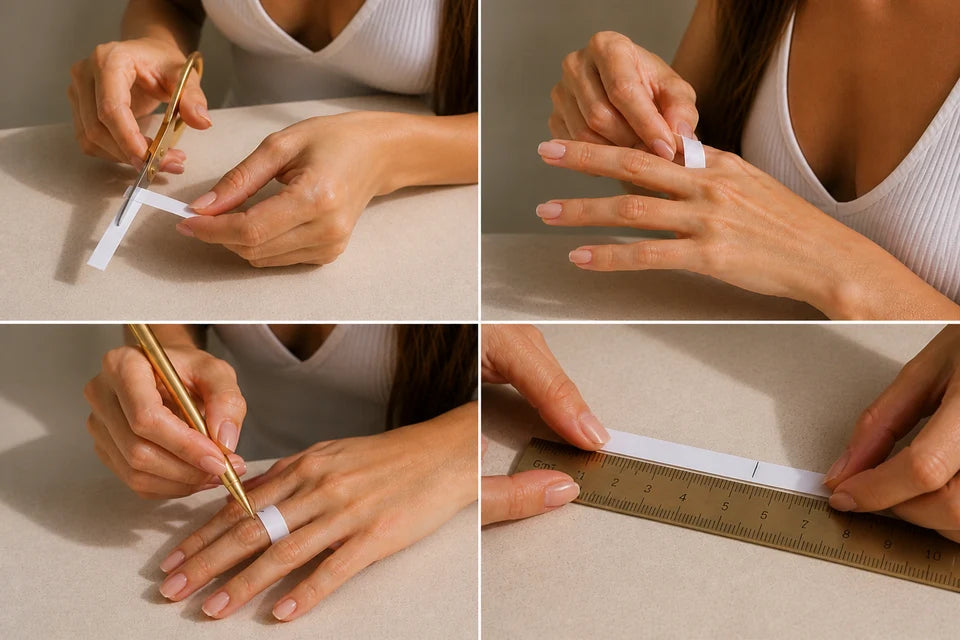
Measure with paper
Wrap a strip of paper around the base of your finger — snug, not tight.
Mark where it overlaps, lay it flat and measure in millimetres. That number is your circumference.
Match it to the chart below. Between two sizes, go up.
When to measure
Fingers swell through the day and shrink in the cold. Measure in the evening, at room temperature, for the size you will actually wear.
Your dominant hand is usually half a size larger.

Stacking
Wearing two or three bands on one finger? Go up half a size on the outer bands so the stack still slides over the knuckle comfortably.
Ring sizes
| US | EU / ISO | UK | Inner Ø | Circumference |
|---|---|---|---|---|
| 6 | 52 | L½ | 16.5 mm | 51.9 mm |
| 7 | 54 | N½ | 17.3 mm | 54.4 mm |
| 8 | 57 | P½ | 18.1 mm | 56.9 mm |
| 9 | 59 | R½ | 18.9 mm | 59.5 mm |
| 10 | 62 | T½ | 19.8 mm | 62.1 mm |
Questions
I am between two sizes. Which do I pick?
Go up. A slightly loose ring is wearable; a tight one is not.
Can a plated ring be resized?
No — resizing damages the plating. Use the guide, and if it is wrong, return it within 30 days.
Does the Vera band run true to size?
Yes. It is a 1.8 mm band, so it sits true. Wider bands generally need half a size up.